Every single SaaS learning management system claims to be the best. So how do you actually decide?
In this guide, we’re breaking down what SaaS LMS platforms really do. We’ll also examine which features actually matter. Overall, we’ll evaluate the options that are worth your time and money.
By the end, you’ll have a clear picture of the best SaaS LMS solutions to consider and feel confident enough to pick a platform in 2026.
So, without any further ado, let's dive in..
What is a SaaS LMS Platform?

The full form of SaaS is software as a service, and the full form of LMS is learning management system.
So, in short, a SaaS LMS is a system that helps you create and manage educational content.
In technical words, a SaaS Learning Management System is a Web-based system. This system stores, administers, and monitors your digital learning material.
So, what makes a SaaS LMS important?
A SaaS LMS platform runs entirely in the cloud. It solves all the technical matters. And the platform runs easily with:
Zero Installation: It is accessed by a web browser. There is never any software to install.
System Updates: The SaaS performs all the upgrades and maintenance. You never have an old-fashioned feature.
Subscription Model: You pay on yearly or monthly basis (or sometimes lifetime).
Scalability: When your business expands, it is easy to add more students or functionality.
The model will allow you to concentrate on your main business. You can use your time to design superior courses. You don’t have to worry about keeping servers.
What Are the Benefits of SaaS Learning Management Systems to Your Business?
A learning management system isn’t merely a course host. It’s a focal business driver. A powerful LMS has numerous advantages for creators and entrepreneurs. It guarantees development and productivity.
#Grow Your Sources of Revenue
An LMS allows selling various goods. Selling video courses or live coaching is possible. You can also sell membership sites and digital goods. All these are an effective passive income combination.
#Streamline and Automate Operations
The manual enrollment and tracking is time wasting. All this is done automatically by a good LMS. It liberates you in marketing and new product development.
#Provide a Professional Brand Experience
Your platform can be customized fully. This involves your domain name, colors, and your logo. You make an online school seamless and branded. This earns you confidence among your listeners.
#Global Reach and Scalability
A learning management system on a cloud is easily scalable. You can be of service to 100 or 100,000 students. The traffic is managed on the platform. Multi-language support, platforms like EzyCourse support 170+ languages that open up global markets.
#Data and Analytics Insight
The current LMSs provide you with profound analytics. It’s possible to monitor student progress and completion. You can also find out which course is driving more sales and engagement. Hence, this information helps in making better business choices.
What Are the Key Features of a High-Performing SaaS LMS?
It’s important to select the appropriate platform for your business. You should not just seek ordinary course hosting. The best SaaS LMS platform should support your entire business. Such as:
Core Content Delivery Tools
Easy and Modern Course Builder
SCORM Compliant
Digital Product Sales
Video Hosting and DRM Security
E-commerce and powerful Monetization
Membership Sites for Recurring Revenue
Tiered Pricing and Bundles
Multiple Payment Gateways
Affiliate Management
Promotion and Social Actions
Built-in Community for interaction
Gamification features
Live Session and Coaching
Marketing and Email Automation Capability
User-Friendly and High-Converting Website Builder
Advanced Analytics and Monitoring
Top 10 Popular SaaS Learning Management Systems for Creators and Businesses
The selection of the most appropriate SaaS learning management system will depend on your objectives. It affects your profit and scaling capacity. We look into the best positions of 2025 that help business people and corporate teams.
Here are the top 10 platforms. We analyze their essential characteristics, advantages, and disadvantages. This analogy is essential in your development.
1. EzyCourse: The All-in-One Platform

Do you want to become a creator and get to be in the driver’s seat all the time? Well, you have EzyCourse, your one-stop shopping. It deals with courses, coaching, digital products, memberships and marketing. The platform is ideal with business people who are creating a strong brand. Moreover, its robust features enable you to generate considerable passive revenues. Gone are the long and tangled integrations and secret charges.
Key Features
EzyCourse offers a potent commission-free platform. It includes an entire site builder to build a completely branded site. You get in-built email automation, advanced interactive form builder, and a Facebook like community option. It also helps to sell online items such as Notion templates and many more.
White-label mobile app (Android + iOS) is also available and comes free with selected plans. This helps to offer education on the go with a user-friendly UI. Your brand goes where your app reaches.

Best Fit Persona Alignment Buyer
Online entrepreneurs and content creators are the most compatible with this platform. It’s appropriate to those who are concerned about maximum profit and complete control. Besides, it’s also superior to big companies and is used to train branded partners and employees.
Pros and Cons
Pros: 100 percent commission free, no transaction charges at all. It has got all the tools under one dashboard. This saves your technology stack price. In addition, it provides white-label mobile applications and over 20+ revenue streams.
Cons: The variety of options can be confusing initially.
To experience a premium LMS platform with robust features, start a 30day free trial with EzyCourse today!
2. TalentLMS: Employee Training: The Best in a Small Business

TalentLMS makes it easy to launch your training program. It’s known for its superior ease of use. This platform is useful in enabling small business teams to begin training today. It fits perfectly well in case you possess limited IT resources. This learning management system is a SaaS that makes life easier.
Key Features:
TalentLMS has a simple and easy to use interface. To improve engagement, it provides powerful gamification capabilities. The platform has SCORM compliance and certifications. It is characterized by fast setup and deployment. It’s also scaled easily by a small number of employees to an augmenting staff.
Best for Buyer Persona Alignment:
This LMS platform is suitable for SMBs and small L&D departments. Besides, it’s applicable in companies that value quick training deployment within the organization. You can also consider it for its low budget requirements.
Pros and Cons:
Pros: Too easy to operate and to install. Pricing is customizable and expandable. It offers a free plan of up to five users that is generous.
Cons: Ecommerce features are simple relative to tools oriented on the creator. The sophisticated customization facilities are restricted as well.
3. Docebo: Ideal in Complex Enterprise Learning

The largest players prefer Docebo. It’s a business level platform that uses high-level Artificial Intelligence. Docebo makes learning a business motivator. It has oversight of employee, customer, and partner training all over the world.
Key Features:
It focuses on AI to provide hyper-personalized learning journeys and content tagging. Docebo has a high level of CRM and HR integration. It serves various learning populations in one place. It has sophisticated analytics that gauge the returns of your training programs. It’s a very scalable platform to millions of users.
Best for Buyer Personality Fit:
Docebo can be an ideal choice for big businesses and multinational organizations. It’s also applicable in organizations that have complicated compliance requirements. Besides, it suits individuals who have high training budget limits the most.
Pros and Cons:
Pros: AI that is leading the industry, and personalization. Ideal compliance and international size. Powerful integrations with a huge ecosystem.
Cons: It is a custom quote-based pricing. This makes it unaffordable to a majority of creators and small businesses.
4. iSpring LMS: Best in Content Authoring

Do you design intricate and interactive content? iSpring Learn is known to provide a simple creation process. It’s fully compatible with the iSpring Suite authoring tool. This renders it an L&D favorite when it comes to the construction of engaging materials. It aids distance learning as well as face to face training.
Key Features:
Its strength is its inbuilt rich content authoring tool. This can be done with quizzes, video simulations and role-plays. It promotes the offline study through an exclusive mobile application. The platform will give comprehensive learner reports. It is superb with speedy content deployment.
Best for Buyer Persona Fitting:
It’s adjusted to L&D professionals and corporate trainers. Moreover, it’s advantageous to producers of proprietary, high-fidelity material on a regular basis.
Pros and Cons:
Pros: Ready integration with iSpring Suite to create content fast. Good quizzing and testing skills. Superior mobile learning services.
Cons: It’s not as ecommerce-oriented in terms of B2C selling. The entire authoring package is an extra expense.
5. Mitratech Perform: Perfect in Talent and Compliance Management

Mitratech Perform is mostly a performance management platform. It’s designed to help organizations align employee goals with business objectives and improve workforce performance. It includes performance reviews, goal setting, continuous feedback, and analytics capabilities.
Key Features:
It is a compliance tracking and performance management specialist. It applies 360 feedback systems and objectives. The LMS module is used to handle compulsory training and development schemes. It is constructed to cater to controlled industries.
Best for Buyer Persona:
The portal is aimed at HR specialists of medium-to-large companies. It is appropriate to organizations that require powerful talents management capabilities.
Pros and Cons:
Pros: Superb connection between the learning and business outcomes. Good compliance and audit trail characteristics. Good when the companies have formal HR processes.
Cons: Performance management puts the learning aspect second. It doesn't have passive income generating features.
6. eduMe: Frontline and Mobile Workforce Training

Does your employee work remotely? eduMe is made to suit remote-workers. It provides microlearning that is bite-sized and instant. This training goes directly to the workers most of the time on their phones. It is very engaging to front line workers.
Key Features:
It is a mobile-first training module, a quick, simple training module. The instruction is presented in the form of interactive and mini learning. It can be combined with such tools as Workday and Microsoft Teams. This offers one-tap access to busy workers. It is constructed around a remote or distributed workforce.
Best for Buyer Persona Alignment:
It suits well with companies that have a huge frontline staff. These are logistics, retail and hospitality. It is concerned with fast knowledge, high retention delivery.
Pros and Cons:
Pros: Deskless workers are engaged at very high levels. Training is immediate and can always be accessed on the mobile. Fits well into the current work tools.
Cons: It has micro-learning content creation. This can curtail extensive and in-depth course material. It does not suit selling external courses.
7. LearnWorlds: Best for High-End Interactive Learning

LearnWorlds shines as the top pick for high-end interactive learning platforms. Creators craft premium academies that wow students with seamless interactivity. They skip developers entirely while building branded course empires effortlessly.
Key LearnWorlds Features
Users embed buttons and quizzes right into videos using the interactive editor. They launch websites, student social networks, and automated transcripts with ease. Branded mobile apps and 1-click marketing funnels boost sales fast.
Ideal Buyer Fit
Entrepreneurs and creators crave LearnWorlds for its upscale premium vibe. Mid-sized businesses thrive by fostering tight-knit training communities around courses.
Pros and Cons
Pros: Interactive video tools dazzle alongside built-in social features and killer SEO.
Cons: The interface demands time to master, and top plans hit wallets hard.
8. Absorb LMS: Best for Scaling Corporate Training
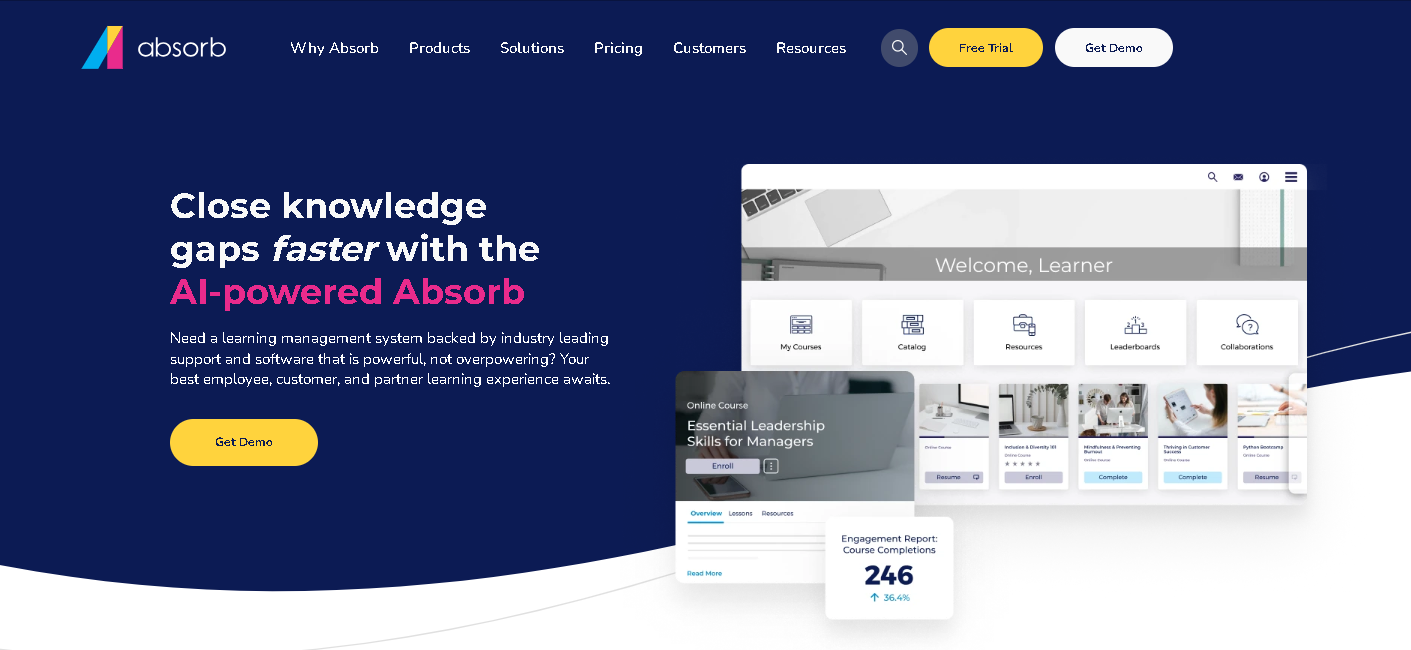
Absorb LMS excels at scaling corporate training programs effortlessly. Companies grow training systems that match their rapid expansion pace perfectly. Award-winning interfaces deliver business wins through smart automation daily.
Core Absorb LMS Tools
Absorb Intelligence uses AI to push personalized content based on user habits. The Mercury Module customizes branding while libraries and compliance trackers hum. Deep Salesforce ties streamline enterprise workflows smoothly.
Perfect User Match
Growing firms and big enterprises automate training for thousands of staff flawlessly. Modern UX fans avoid clunky designs for this sleek powerhouse.
Pros and Cons
Pros: Stellar UI/UX pairs with AI smarts and top-tier support for enterprises.
Cons: Prices soar past creator tools, overwhelming solo Notion template sellers.
9. Canvas LMS: Ideal in Academic and Higher Education

Canvas LMS is best in the world of universities. It gives powerful grading, assignments, and scholarly collaboration instruments. It establishes a formal systemic distance-learning atmosphere.
Key Features:
Canvas possesses a good gradebook and assessment systems. It has such features as SpeedGrader to provide teachers with efficiency. It facilitates the incorporation with other academic tools (LTI). It is formulated towards academic cooperation and structured learning paths.
Best for Buyer Persona Fit:
This LMS is ideal to colleges, universities, and K-12 schools. It fits well with formal learning institutions.
Pros and Cons:
Pros: Extremely reliable and rich in features to be used in academies. Superior student management and graders.
Cons: Ecommerce functionality does not exist. It does not exist to assist online businesspersons to sell courses as a profit-making activity.
10. MoodleCloud: Best Open-source Cloud Simplicity

Moodle is an open-source LMS which is the most popular of all the world. MoodleCloud provides this open-source power without the technical hitches. You have a dependable, cloud-based version. It’s very adaptable and community based among educators.
Key Features:
It boasts of immense diversity of activities and course formats. It has an enormous ecosystem of functionality Add-ons. MoodleCloud has basic installation and maintenance of the site. You are enjoying a big international user and developer base.
Best for Buyer Persona Alignment:
This platform will suit educators and developers. It fits those people and non-profits that require utmost flexibility but at a low cost.
Pros and Cons:
Pros: Open-source doesn’t require self-hosting. It’s usually very cheap with regard to constrained IT resources.
Cons: In many cases, advance customization assumes technical experience to the open-source platform. Also, the interface may be old-fashioned in accordance with the contemporary SaaS solutions.
Comparison Table
This table compares key features, pricing models, and the best-suited audience for each SaaS LMS platform.
LMS Platform | Best Suited For | Key Feature Highlight | Primary Pricing Model | E-commerce/Monetization |
1. EzyCourse | Online Entrepreneurs & Large Companies | All-in-One Site Builder, No Transaction Fees, White-Label Mobile Apps. | Tiered Subscription (Starts ~$45/mo) | Excellent (Built-in): Courses, Notion Templates, Memberships. |
2. TalentLMS | Small to Mid-Size Businesses (SMB) | Extreme Ease of Use, Gamification, Fast Deployment. | Per-user/active user (Starts ~$119/mo) | Good: Integrated with PayPal/Stripe for basic sales. |
3. Docebo | Large Global Enterprises | AI-Powered Personalization, Multi-Audience Portals, Skills Management. | Custom Quote (Yearly Active Users) | Limited: Focused on customer/partner education, not retail. |
4. iSpring Learn | Corporate Trainers | Native Integration with iSpring Authoring Tools, Offline Mobile App. | Pay-per-Active-User (Custom Quote) | Basic: Designed for internal training, not a storefront. |
5. Mitratech Perform | HR & Compliance | Integrated Performance Management and Compliance Tracking. | Custom Quote (HR Suite) | N/A: Internal corporate training and HR only. |
6. eduMe | Remote Workforce | Mobile-First Microlearning for deskless teams. | Custom Quote (Usage-based) | N/A: Purely for internal employee engagement. |
7. LearnWorlds | Premium Creators | Interactive Video Editor, Built-in Social Network, 1-Click Funnels. | Subscription (Starts ~$29/mo + $5 fee) | Excellent: High-end school branding and marketing tools. |
8. Absorb LMS | High-Growth Companies | AI-driven "Absorb Intelligence" and Award-Winning UI/UX. | Custom Quote (Scaling) | Moderate: Supports external sales but built for corporate. |
9. Canvas LMS | Academic Institutions | Robust Grading, Academic Assessments, LTI Integrations. | Custom Quote (Institutional) | Poor: Not built for commercial course sales. |
10. MoodleCloud | Educators/Developers | Open-Source Core Flexibility, Huge Plugin Ecosystem. | Tiered Annual Fee (Starts ~$130 USD/year) | Fair: Needs plugins to handle advanced monetization. |
Key: A platform with a focus on "Excellent" monetization is best for the entrepreneur or content creator aiming for passive income. Platforms focused on "N/A" or "Limited" are best for internal corporate or compliance training.
Ready to simplify your digital business? See how EzyCourse’s all-in-one platform can host your courses, products, and community today.
How to Implement a SaaS LMS Platform in Your Organization

There is no need to make the implementation painful. There is a systematic method of success. These steps will result in the seamless rollout.
1. Assess Your Learning Needs:
What do you want? Are you selling to the customers, or training employees? Record the needed functionality, such as membership sites or compliance monitoring.
2. Research and Select the Right SaaS LMS:
Use this guide to shortlist 2-3 platforms. Test the free trials. Make sure that the platform can support your content and monetization strategy.
3. Prepare Your Content:
Transform Your Videos, PDFs and Quizzes into the correct formats. Arrange them into sequential learning. This is where your Notion templates have the capability to get organized courses.
4. Deploying Best Practices:
Configure your branding and custom domain name. Install your payment gateways. This puts the system in business readiness.
5. Educate Your Team:
Educate your content creators/ administrators. They should be aware of how to make use of everything. The system is expected to have detailed support documentation.
6. Get the User Adoption:
Publicize the new platform to your students or employees. Emphasize on the advantages to them. Learning should be fun with the help of gamification.
7. Review Advanced Analytics:
Monitor and optimize, examine the engagement rates and completion of the courses. This information should be used to constantly evolve your learning programs.
What are the Drawbacks of SaaS LMS Implementation?

Although good, SaaS model has its problems. The knowledge of these will guide you in making a good decision.
*Frauds of a Pricing Model
A lot of sites are imposing a hidden transaction fee. Others impose additional fees to have additional storage. Make sure you shortlist a platform that doesn’t charge any transaction fee such as EzyCourse. This maximizes your profit.
*License Restrictions
Some platforms impose severe restrictions on important aspects. These are the limited user numbers or course creation. The topmost levels are usually closed to enterprise-level features. Be sure to look at the fine print to know the limitations of the user.
*Unviable or Difficult Customization
Your brand is everything. Most of the basic LMS systems fail to offer in-depth customization. Only a fundamental logo can be provided by them. Select a platform that has good white label branding and advance customizable site builder.
*LMS Selection Criteria for SMBs
If you are an entrepreneur or a small business, you definitely have different needs. Therefore, it requires the combination of a corporate system and creator monetization.
*Priority Built-In Ecommerce Functionality
In B2C model, the major objective is selling. The site should provide hassle-free checkout and payment procedures. It should support one-time sales and recurring membership websites with ease.
*Scalability and Support of Multiple Products
You should sell additional products other than courses. Consider selling coaching programs, paid communities, and digital downloads. Therefore, the platform should be capable enough to manage all your future passive income streams.
*Freud-Friendliness to Non-Technical Founders
You are an inventor, not an innovator. Therefore, the interface should be user friendly. It must enable you to easily create a website, courses and execute email campaigns without complications. An excellent user experience (UX) is cost-effective and time-saving.
*Total Cost of Ownership (TCO)
Include subscription and transaction charges. Remember about the cost of necessary integrations. The combined cost of software stacks is severely reduced on a single all-in-one platform.
Why Choose EzyCourse as Your SaaS LMS Platform

EzyCourse is built to suit people like you. This is the best possible option if you want a single platform where you can do everything.
👉No Transaction charges to maximize profit
Your profits belong to you. EzyCourse is not charging a percentage of your sales. 100% commission-free. This is the one and the biggest cause of increasing passive income.
👉Unconquerable All-in-One Features
Five different tools? Why spend unnecessary money on them?
Instead, you can get a complete learning management system on a SaaS basis with strong marketing. EzyCourse comes with a modern site builder, email automation, digital products, community, memberships, and more.
👉White-Label Ready Your Brand
Your brand is the star. You can have a complete white-label customization with EzyCourse. This entails your branded iOS and Android mobile applications. It forms the final working experience.
👉One Platform for Both Creators and Large Companies
The features of EzyCourse platform are scaled to any desire. The simple course can be initiated by small business entrepreneurs. Membership features can be applied in employee upskilling within large companies. They are also able to utilize our course features in partner education and compliance. It’s a highly multifunctional solution.

Ready to Choose Your Best Fitted SaaS LMS?
The transition to online studies is not decelerating. The right SaaS LMS platform is your most important business tool. It keeps you competitive and allows to maximize your earnings. Therefore, select a platform that appreciates your success. A platform which will make your life easier.
EzyCourse is what fulfils all these requirements and empowers you to create, manage and grow. Get in control of your content and your brand now. The knowledge you have is what your future customers are waiting for.
Stop losing profits to transaction fees and messy integrations. Join thousands of creators and businesses building their future on EzyCourse. Start your 30day free trial and launch your dream online school today!

FAQs
1. What is the main difference between a SaaS LMS and a traditional LMS?
SaaS Learning Management System is a cloud-based system. The software is located and managed by the vendor. Another type of LMS is a conventional LMS that is self-hosted. It operates on the servers of your own company.
2. Are SaaS LMS platforms secure for corporate training?
Yes, the best SaaS LMS platform vendors invest heavily in security. These have good security measures compared to the majority of small company IT teams. Find such characteristics as DRM and SCORM compliance.
3. Is it possible to sell digital downloads such as Notion templates through an LMS?
Yes. Such platforms as EzyCourse are made to sell various digital products. Platforms usually have special checkout and delivery apps.
5. Which SaaS LMS is best for starting a passive income business?
Find an all-in-one platform with no transaction or hidden fees. It has to integrate an easy to use course builder with powerful marketing features. Platforms like Thinkific, Teachable and EzyCourse are best suited to this kind of passive income.