
Numerous brands are joining the trend, producing video streams, and generating revenue to maintain viewer engagement.
But with so many OTT platform providers, it's a real challenge to choose the right one for your video monetization website.
With all the features, pricing options, and technical stuff to think about, it’s easy to get lost.
To help you out with the selection, we have gathered 11 of the best OTT platform providers with excellent cards to consider.
Let’s jump over that!
TL;DR
Vimeo: Most popular overall; best for professional creators, businesses, and high-quality VOD/OTT with easy monetization and branding.
Brightcove: Strong enterprise presence; best for large-scale professional video management, OTT, and advanced analytics at scale.
Kaltura: Frequently mentioned in enterprise and education; best for robust video CMS, hybrid deployments, and compliance-heavy organizations.
Dacast: High visibility in live + VOD lists; best for affordable live streaming combined with on-demand, monetization, and global delivery.
Uscreen: Popular for creator-focused OTT; best for subscription-based memberships, courses, and community video platforms.
Muvi (one): Common in white-label comparisons; best for all-in-one end-to-end OTT/VOD with apps, monetization, and enterprise features.
JW Player: Regular in player and publisher lists; best for customizable, high-performance video players with ad support.
VPlayed: Frequent in white-label and OTT articles; best for fully customizable end-to-end VOD/OTT with multiple monetization models.
Wowza: Solid mentions for live/tech setups; best for flexible live streaming, self-hosted options, and enterprise infrastructure.
Zype: Moderate mentions in OTT guides; best for modular video distribution and monetization-focused streaming services.
Setplex: Niche visibility; best for managed white-label OTT solutions and multi-device content delivery.
Don’t Confuse between OTT Platforms & OTT Platform providers
Before we dive into the list, let’s clear up one of the most common (and costly) misunderstandings.
When people hear “OTT platforms,” they often think of services like Netflix or Disney+—places where you go to watch movies and shows. And they’re not wrong… But that's only half the picture.
What you’re actually looking for in this guide is something different.
OTT platform providers like Uscreen or Muvi- are the tools that let you build your own streaming platform.
Think of them as the engine behind the scenes. They handle everything from video hosting and streaming to subscriptions, payments, and even launching your own branded app.
Here’s a simple way to look at it:
OTT platforms = Where audiences watch content
OTT platform providers = How creators and businesses build those platforms
Aspect | OTT Platforms | OTT Platform Providers |
Primary Users | Viewers/audience | Creators, businesses, educators |
Main Purpose | Content consumption | Content hosting, management, and monetization |
Content Ownership | Owned/licensed by platform | Owned by you (creator/business) |
Monetization Model | Subscriptions, ads, pay-per-view | Subscription setup, memberships, PPV (controlled by you) |
Customization | Limited (fixed UI/UX) | High (white-label, branding, apps) |
Technical Control | None for users | Full control over the platform and experience |
Now, let’s know 11 Best OTT Platform Providers in detail
Here, we are going to show 11 ideal platforms that you can choose for your streaming needs.
So, let’s get into the details:
1. Vimeo

Vimeo is a well-established video hosting and streaming platform that also enables OTT-style experiences through its dedicated product, Vimeo OTT.
Creators, educators, and businesses widely use it to host, manage, and monetize video content without dealing with complex technical setups.
Using it is pretty simple, and the blessing is that it doesn’t require technical skill or an expert to upload or stream videos.
You can make it (upload videos) in bulk from cloud storage.
For developers and advanced users, Vimeo provides APIs and SDKs to customize workflows and integrate video into existing systems.
Additionally, it uses adaptive streaming to automatically adjust video quality based on the viewer’s internet speed.
You can earn revenue (monetization options) through live streaming, subscription sales, and PPV events.
If you think you don’t want to try this or readout the whole blog, here’s Vimeo alternatives that can help.
Here are the top features of Vimeo
High-quality video hosting (HD & 4K support)
Vimeo OTT for subscription-based streaming platforms
Adaptive bitrate streaming
Live streaming for events and webinars
Advanced analytics and viewer insights
Monetization options (SVOD, TVOD, PPV)
Custom branding and white-label capabilities
Integrations with tools like Zoom and marketing platforms
Cons
Vimeo OTT is not included in standard plans (separate pricing)
Pricing increases significantly as you scale
Storage and feature limits on lower-tier plans
Transaction fees may apply depending on the monetization setup
Pricing

Free — $0 (limited storage ~1 GB, basic features, Vimeo branding)
Starter — $20/month, basic video hosting with ~2 TB storage
Standard — $41/month, more advanced tools, and ~4 TB storage
Advanced— $125/month, includes live streaming, events, and ~7 TB storage
Enterprise — Custom pricing, tailored for large teams and high usage
Note: Vimeo OTT pricing is separate and typically requires a custom plan.
So, if you’re looking for a high-quality video platform with built-in monetization potential, Vimeo is a strong choice—especially for creators and small businesses.
2. Brightcove

Brightcove is another best OTT platform provider for those who need reliable, scalable, and high-performance OTT delivery.
It allows you to stream live events, host on-demand video libraries, and distribute content across multiple devices.
All of these features make it easier to manage, publish, and scale video content without handling complex backend systems (using cloud-based infrastructure).
However, Brightcove stands out for its robust streaming technology, global CDN delivery, and reliability, making it suitable for large audiences and mission-critical video operations.
It also provides APIs and integrations to connect with marketing tools, CRMs, and custom workflows—though setup can require technical involvement.
Top Features from Brightcove
Robust Video API, SDKs, and pre-built integrations for deep customization
High-quality live streaming with real-time engagement tools
Advanced analytics to track viewer behavior and optimize performance
Enterprise-grade security, including multi-DRM protection
Global content delivery through top-tier CDNs for fast, reliable playback
OTT app-building tools (Beacon Studio) for branded experiences across devices
Flexible monetization options, including ads, subscriptions, and transactional VOD
Cons
Expensive compared to creator-focused platforms
Complex setup for beginners or small teams
Not ideal for small businesses or solo creators
Is Brightcove the Right Choice for You?
Brightcove is a strong fit if you need enterprise-level video streaming with high reliability and global delivery.
It’s especially useful for media companies, large businesses, and organizations handling high-volume video distribution.
However, if you're a small creator or startup, the pricing and technical setup might feel overwhelming. In that case, simpler OTT platforms may be a better starting point.
Pricing
Brightcove does not publish fixed public monthly pricing.
The Plans (Starter, Essential, Premium, and higher tiers) are custom-quoted based on your storage, bandwidth, live streaming hours, users, and features.
Most users report starting costs well above $1,000/month with annual contracts. Contact Brightcove sales for a tailored quote.
3. Kaltura

Kaltura is an efficient OTT platform that offers a reliable way to stream webinars, town halls, meetings, and virtual classrooms.
No matter if you’re hosting virtual meetings, pitching ideas, or running online classes, this platform provides a solid space for pro-like streaming.
Unlike other platforms, it is open-source, which means you have full control over your data. This platform also allows custom integrations, so you can adjust the platform to fit your needs.
If you have many videos to store and share, this platform makes it easy with cloud-based hosting and a branded video player. You also get detailed insights with its top-notch analytics to track performance.
However, this platform doesn’t come with a solid built-in recording studio. Besides, it has no advanced monetization options like coupons and credits.
On the whole, Kaltura is a great option for those who need a customizable and professional video streaming platform.
Top Features
API-first architecture for deep customization
Video hosting and management (VOD + live streaming)
Support for webinars, virtual events, and online learning
Customizable video player and branding options
Advanced analytics and audience insights
Integration with tools like Zoom, HubSpot, and Webex
Multi-device delivery (web, mobile, OTT environments)
Interactive video tools (quizzes, hotspots, branching)
Cons
Requires technical expertise for setup and customization
Pricing is not transparent and can be expensive
Interface can feel complex compared to modern SaaS tools
Should You Consider Kaltura?
If you’re running a large-scale video operation and need full control over customization, integrations, and delivery, Kaltura stands out as a powerful solution.
It’s especially valuable for enterprises and educational institutions managing complex video workflows.
Pricing

Since Kaltura offers many pricing plans for virtual events, video management consoles, webinars, and more, you need to contact the sales team for details.
4. Dacast

Dacast is a high-quality OTT platform that offers both live streaming and on-demand videos.
The use of it is very easy, sounds secure and feels flexible.
You also get a white-label video player that can be embedded into your website or app, allowing full branding control without third-party distractions.
It also supports different revenue models like pay-per-view, subscriptions, and ad-based monetization. Thanks to its flexibility, you can run an online course, host events, and sell memberships to earn money passively.
While it offers strong monetization and streaming capabilities, some advanced features are limited to higher-tier plans.
Top Features
1080p to 4K video resolution.
Record your live streams for later viewing.
Secure video hosting (password protection, geo-restrictions)
Contain SVOD, AVOD, and TVOD monetization tools.
Global content delivery via CDN
Get real-time analytics to track performance.
Allow white-label and branding control.
Cons
Learning curve for first-time users
UI can feel outdated compared to modern platforms
Advanced features locked behind higher pricing tiers
Not ideal for large-scale OTT app ecosystems
Is Dacast the Right Choice?
If your focus is secure, reliable streaming with built-in monetization, Dacast is a practical choice.
Remember, it’s not the simplest platform to master, but if you’re okay with a short learning curve, you get a solid balance between control, security, and scalability.
Dacast Pricing

(Pricing varies based on bandwidth and storage usage)
Starter — $39/month (billed annually), 2.4 TB/year bandwidth, 500 GB storage
Event—$63/month (billed annually), 6 TB one-time bandwidth, 250 GB storage
Scale — $165/month (annual) or $250/month (monthly), 24 TB/year bandwidth, 2 TB storage
Custom — Custom pricing for enterprise needs with flexible bandwidth and storage
5. Uscreen

Uscreen is a creator-focused OTT platform built to help you launch, monetize, and grow your own video streaming business.
It’s designed for content creators, coaches, and educators who want to sell video content through subscriptions, memberships, and live events—without relying on third-party platforms.
Even though Uscreen provides everything in one place: video hosting, website building, community features, and monetization tools.
You can also launch branded apps across iOS, Android, Roku, and Apple TV, giving your audience a seamless viewing experience across devices.
With all of these, however, this platform is pretty costly for newbie creators. It lacks options like assessment, progress tracking, and video hosting.
So, if you want, you can consider this- Uscreen alternative blog to read.
Top Features
Video hosting with built-in CMS
Subscription, membership, and PPV monetization
Branded apps (iOS, Android, Roku, Apple TV)
Live streaming with chat and event scheduling
Built-in community and engagement tools
Content organization (playlists, filters, drip content)
Bulk upload and cloud import (e.g., Dropbox)
Cons
Higher pricing compared to basic video platforms
Transaction or subscriber-based fees can add up
Customization can feel restricted compared to fully custom OTT builds
Requires time to fully set up and optimize your platform
Is Uscreen a Good Suit?
Uscreen is one of the most complete platforms available if your goal is to build a subscription-based video business with strong community engagement.
It’s especially effective for creators who want to own their audience and revenue.
Pricing

Starter — $49/month, $0 subscriber fee, 100 subscribers limit, 20h storage
Growth— $199/month, $1.99 per subscriber, unlimited subscribers, 100h storage
App Essentials— $499/month, $0.99 per subscriber, includes mobile apps (iOS & Android)
Custom— Contact sales for the pricing (according to your needs)
6. Muvi (One)

Muvi supports several products, and the Muvi One is the one we are talking about here.
Muvi (Muvi One) is a fully managed, all-in-one OTT platform designed to help businesses launch Netflix-style streaming services without building the infrastructure from scratch.
It supports both video and audio streaming, allowing you to deliver live and on-demand content across web, mobile, and smart TV apps.
With its white-label system, you can create a completely branded streaming platform tailored to your business.
Though it provides a complete OTT ecosystem but includes hosting, CMS, monetization, and app distribution—all in one place.
However, this level of completeness comes with higher pricing and a more complex setup compared to creator-focused platforms.
Top Features
End-to-end OTT platform (hosting, CMS, delivery)
White-label streaming across web, mobile, and TV apps
Built-in monetization (SVOD, TVOD, AVOD)
Muvi Kart for selling physical or digital products
Global content delivery with CDN integration
DRM and advanced content security
Multi-screen streaming and device compatibility
API support and third-party integrations
Cons
Expensive compared to most OTT platforms
UI can feel overwhelming for first-time users
Setup and onboarding can feel complex for beginners
Limited built-in marketing tools compared to creator-focused platforms
Should You Opt for Muvi?
If you want a fully managed OTT platform with apps, hosting, and monetization built-in, Muvi is one of the most complete solutions available.
It’s ideal for businesses that prefer an all-in-one system over managing multiple tools.
Pricing (annually)

Standard — $339/month, up to 1K concurrent users, includes website & apps, basic support
Professional — $1,274/month, up to 5K concurrent users, includes advanced features & integrations
Enterprise — $3,315/month, up to 50K concurrent users, dedicated server & higher performance
Ultimate — Custom pricing (starts around $10,000/month), 50K+ users, full customization & infrastructure
7. JW Player

JW Player is a video delivery and monetization platform best known for its high-performance HTML5 video player and streaming infrastructure.
It helps businesses and publishers stream live and on-demand content while optimizing playback quality and audience engagement.
Unlike full OTT builders, JW Player focuses more on video delivery, advertising, and performance optimization rather than creating complete Netflix-style platforms.
With support for modern streaming technologies, APIs, and integrations, it’s widely used by media companies that need scalable video delivery and ad-based monetization.
However, it’s less suited for creators looking for an all-in-one OTT platform with built-in apps and subscription systems.
Top Features
Live streaming and video-on-demand hosting
Advanced ad monetization (AVOD, SSAI support)
Video delivery optimization and fast playback
API access for integrations and customization
Real-time analytics and audience insights
Multi-device compatibility (web, mobile, apps)
DRM and content protection options
Cons
Not a full OTT platform (limited for building streaming apps)
Subscription monetization (SVOD) is not as strong as OTT-focused tools
Requires technical setup for advanced use cases
Customer support response time can vary
Should You Opt for JW Player?
If your focus is high-quality video delivery with strong ad-based monetization, JW Player is a solid choice.
However, if you’re planning to build a full OTT platform with apps and memberships, you’ll likely need a more complete solution.
Pricing
JW Player does not publicly list fixed monthly pricing. You have to contact with the team.
Here’s the info that the JW Player costs vary based on streaming volume, delivery, and monetization features.
8. VPlayed (aka Contus VPlayed)

VPlayed is a customizable OTT platform built for businesses and content owners who want full control over their streaming infrastructure and branding.
It allows you to launch and manage video-on-demand and live streaming services across web, mobile, and smart TV platforms.
One of its key advantages is flexibility- you can choose between cloud or self-hosted deployment depending on your technical and business needs.
With strong monetization options, security features, and scalable delivery, VPlayed is best suited for organizations aiming to build a fully branded, enterprise-level streaming platform.
Top Features
White-label OTT platform with full branding control
Support for live streaming and video-on-demand (VOD)
Multi-device compatibility (web, mobile, smart TV apps)
Built-in monetization (SVOD, TVOD, AVOD)
DRM and advanced content security
Adaptive bitrate streaming via HLS player
Detailed analytics and reporting
API support for integrations and customization
Cons
Pricing is not transparent (custom quotes only)
Setup and configuration can be complex
Requires technical involvement for full customization
Not ideal for beginners or solo creators
Pricing
VPlayed does not publicly list its pricing plans.
Interested users are required to contact their sales team directly for customized quotes based on specific requirements and desired features.
9. Wowza

Wowza is a strong OTT streaming platform that supports both live and on-demand video streaming. It also offers flexibility with cloud streaming, private cloud options, and on-premises solutions.
With that, this platform offers a content delivery network (CDN) that helps ensure smooth video playback.
You can also customize the viewing experience by adjusting playback settings, video quality, and streaming networks.
For ease of usage, it comes with the latest tools, APIs, and integrations to build customized streaming workflows. The platform also supports 4K streaming, live stream recording, and video on demand.
Moreover, the platform provides options to monetize your content with ad tags and schedules. With that, you can ensure passive revenue.
Top Features
Live streaming and video-on-demand support
Low-latency streaming capabilities
Cloud, on-premises, and hybrid deployment options
Streaming engine for custom workflows
API access for integrations and automation
Support for 4K and adaptive bitrate streaming
Integration with CDN providers
Cons
Not a plug-and-play OTT platform
Requires technical expertise to set up and manage
Monetization features are not built-in (requires integrations)
Analytics are limited compared to OTT-focused platforms
Interface can feel complex for non-technical users
Determining if Wowza Suits Your Business
If you need full control over your streaming infrastructure and low-level customization, Wowza is a powerful option.
It’s ideal for developers and businesses building custom streaming workflows at scale.
However, if you’re looking for best OTT platform with built-in monetization and apps, this may feel too technical and incomplete.
Wowza Pricing

Pay As You Go — $0/month (usage-based pricing applies)
Basic Monthly — $195/month
Enterprise — Custom pricing
10. Zype

Zype is an API-first video platform designed for businesses that want to build and manage their own OTT streaming services with full flexibility.
Instead of offering a rigid, all-in-one solution, Zype provides modular tools for video hosting, content management, monetization, and distribution.
This allows developers and teams to create custom OTT experiences tailored to their exact needs.
It supports live streaming, video-on-demand, and multi-platform delivery, making it suitable for media companies and enterprises that need scalable and customizable video infrastructure.
However, its flexibility comes with complexity, meaning it’s better suited for teams with technical resources rather than beginners.
Top Features
Video hosting and management (VOD + live streaming)
OTT app distribution (web, mobile, smart TV)
Built-in monetization (SVOD, TVOD, AVOD)
Multi-platform video delivery and syndication
Integration with third-party tools and workflows
Subscriber and user management system
Analytics and audience insights
DRM and content protection options
Cons
Not beginner-friendly compared to plug-and-play OTT platforms
Pricing is not transparent upfront
Custom development can increase total cost
UI and workflow may feel complex for non-technical users
Pricing

Zype has two plans
Zype X: $500/ month (for agile teams looking for a robust streaming foundation)
Zype Premium: $3500/ month (for high-growth and enterprises managing teams)
Though its pricing is not fixed. You can even contact the sales teams for final pricing, which will depend on OTT apps, monetization setup, and the infrastructure you need.
11. Setplex

Setplex is the best OTT and IPTV platform that is designed for telecom operators, ISPs, and media companies (that want to deliver fully managed streaming services at scale).
It provides a complete ecosystem—including middleware, OTT apps, content management, and subscriber handling—allowing businesses to launch and operate their own branded streaming platforms across multiple devices.
This performs acts like a creator-focused tool with carrier-grade infrastructure, making it ideal for organizations that need high performance, scalability, and deep system control.
Top Features
End-to-end OTT & IPTV solution (middleware + apps + backend)
Multi-device streaming (web, mobile, smart TVs, set-top boxes)
Flexible monetization (subscriptions, advertising, PPV, rentals).
White-label apps with full branding control
API and integration support for custom workflows
Support for live TV, VOD, and catch-up TV
Advanced DRM and content protection
Scalable infrastructure for telecom-grade delivery
Cons
Setup and deployment can be time-consuming
Not beginner-friendly; designed for enterprise use
Overkill for small creators or simple OTT needs
Pricing
We found no specific pricing plans on its site. Maybe it takes custom pricing. You have to knock on the sales/ team for purchase.
7 Types of OTT Platforms Monetization Options
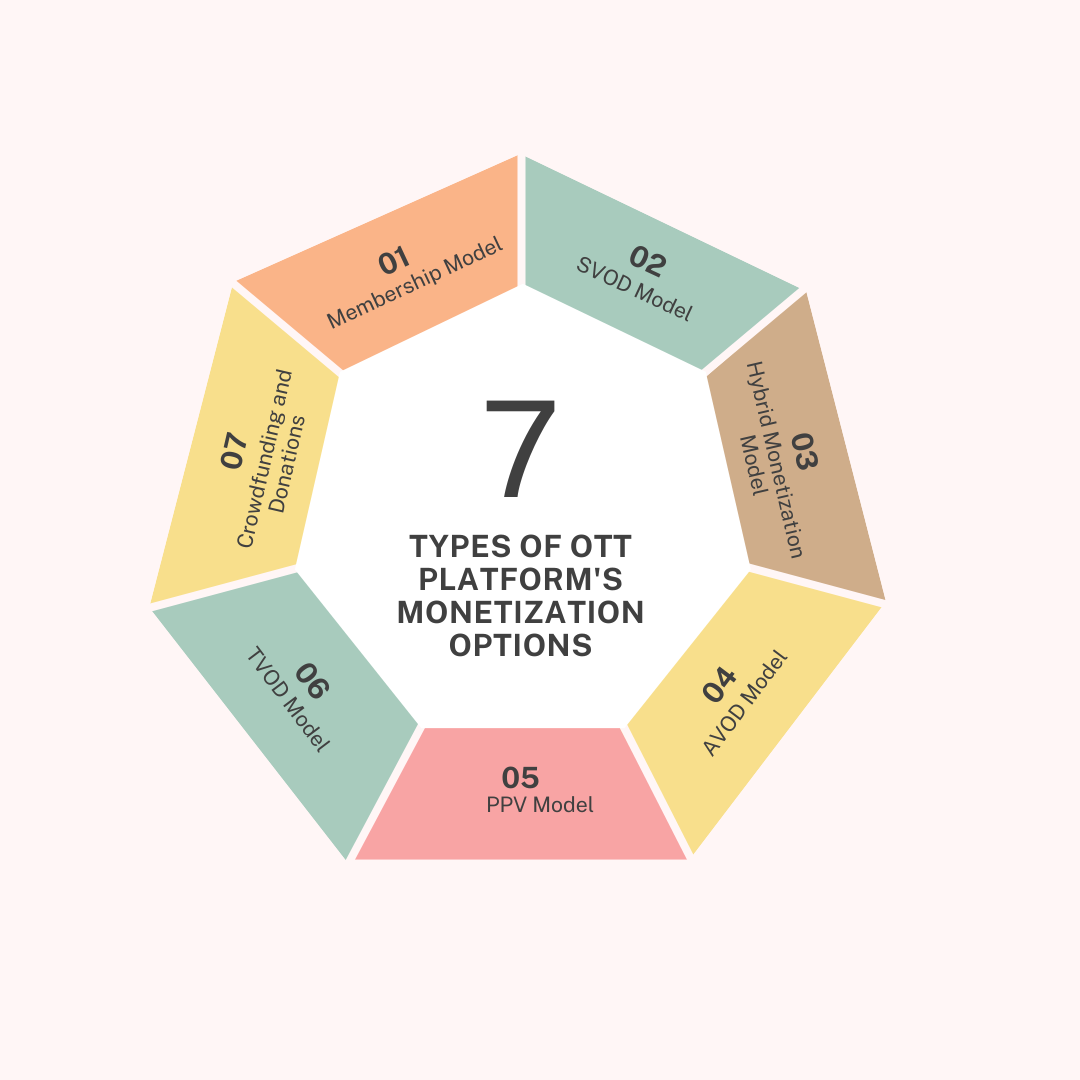
We have seen that most of the platforms has monetization options. So, you can earn with them.
Some platforms let users subscribe for unlimited access, while others let them pay per video or watch content with ads.
Here are the most common OTT monetization methods used today.
Membership Model
This model is similar to SVOD but includes exclusive perks like access to private communities, special content, or extra features.
Some services also offer multiple membership levels. In this model, higher-tier members receive additional benefits.
Subscription-Based Video on Demand (SVOD)
SVOD requires users to pay a monthly or yearly fee to access a library of content. Once they subscribe to this service, they can watch unlimited videos without extra charges.
Hybrid Monetization Model
Hybrid monetization is where things get more interesting.
Some platforms, including VPlayed and Kaltura, allow you to combine multiple models—like offering a lower-cost subscription with ads and a premium ad-free version.
This flexibility lets you target different audience segments without limiting your revenue streams.
Advertising-Based Video on Demand (AVOD)
The AVOD (Advertising Video on Demand) model is another popular option, especially for platforms focused on reach.
Tools like JW Player and Brightcove are strong here, enabling you to monetize through ads placed before, during, or after videos.
Instead of charging users directly, revenue comes from advertisers.
Pay-Per-View (PPV)
For live events and exclusive content, PPV (Pay-Per-View) is commonly used.
Platforms such as Dacast make it easy to charge users a one-time fee to access a specific live stream- like a webinar, concert, or sports event.
Transaction Video on Demand (TVOD)
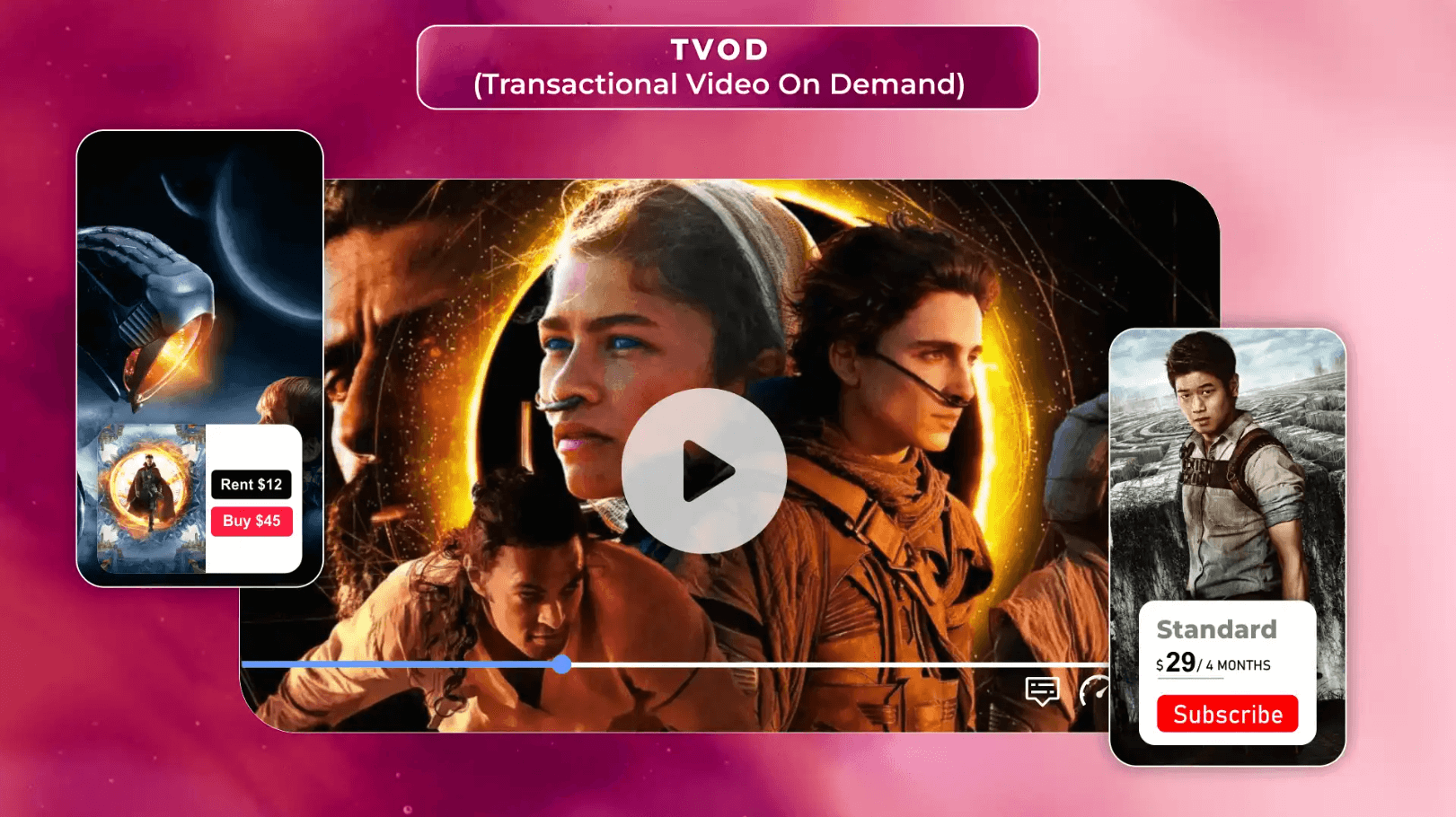
Closely related is TVOD (Transactional Video on Demand), in which users pay for individual content items.
OTT solutions like Muvi support this model, letting users rent or purchase videos individually rather than committing to a subscription.
Crowdfunding and Donations
This model enables viewers to directly support creators through platforms such as Uscreen or other donation-based systems.
It is commonly adopted by independent content creators.
Platforms often offer various ways to set prices and make money, including options like tiered pricing and special deals.
For those looking to build a comprehensive video subscription platform, understanding these monetization strategies is crucial.
How to Choose the Best OTT Platform Provider
Now you know what OTT platforms are and how they work.
You should choose a platform that gives a seamless experience for both you and your audience.
Plus, it should offer several ways to earn money passively.
Here are the key factors to consider when picking the right one for your business.
Monetization Flexibility: Look for platforms that support multiple models like subscriptions, pay-per-view, and one-time purchases. This lets you easily monetize courses, communities, and digital products.
Interactive Features: Choose platforms with live chat, polls, quizzes, and shoppable links. These tools boost audience engagement and help improve retention rates.
Stability & Scalability: Your platform must be reliable and handle growth without sudden downtime. It should smoothly manage more viewers and expanding content needs as your business scales.
High-Quality Streaming: Go for smooth playback that automatically adjusts quality based on internet speed. This delivers crisp, buffer-free viewing for a premium experience.
Customization & Branding: Pick a platform that offers white-label options, custom domains, and your own logo. It should let you fully match the interface to your brand’s look and feel.
Analytics & User Insights: A strong dashboard is essential to track watch time, engagement, and revenue. Use this data to optimize your content and refine your monetization strategy.
User Experience & Accessibility: The interface should be simple for both you and your viewers. Ensure it works well across web, mobile, smart TVs, and includes easy navigation plus accessibility features.
Can EzyCourse Be Your OTT Platform Provider?
The short answer is yes, but only in specific scenarios.
Here they are:
Unlimited video hosting and a robust built-in video library with adaptive streaming.
Live streaming for webinars, classes, and events (with Zoom integration).
Advanced content security features such as DRM protection, AI-generated subtitles, and piracy safeguards.
Multi-device delivery- Web, mobile (iOS & Android apps via white-label options), and smart TV compatibility.
Flexible monetization: Subscription (SVOD), pay-per-view, one-time purchases, memberships, and hybrid models.
Full white-label & branding: Build your own professional video portal without “powered by” branding.
Additional power tools: Drag-and-drop website builder, community features, email marketing, and analytics — all in one dashboard.
Note: EzyCourse is not a pure heavy-duty enterprise OTT infrastructure provider (like dedicated media companies handling millions of concurrent streams)
FAQs on Best OTT Platform Provider
1. What is the difference between OTT and streaming?
OTT refers to sending digital content directly to a user’s device, such as a TV, phone, or laptop. Then again, streaming means sending content via the internet in a live or recorded form. In fact, streaming means the combination of OTT and CTV.
2. How is OTT Delivered?
OTT is delivered via the internet. In other words, it uses the public internet and bypasses the traditional cable or satellite providers. Then, it offers on-demand access to different devices like TVs, phones, and so on.
3. What is the difference between OTT and cable TV?
The main difference between OTT and cable TV is the use of cable or satellite. You see, the OTT platforms don’t need cable or satellite to stream; instead, they use the internet. On the other hand, cable TV uses these to stream.
4. Can I stream live events on OTT platforms?
Yes, you can! A lot of OTT platforms allow live streaming and events with options like live chat, Q&A, and other helpful tools. Plus, you can find some platforms that let you host pre-recorded live events and accept PPV events.


