
Key takeaways
Discord has 259 million monthly active users, but over 54% of them are now non-gamers. Most people using it are already on the wrong platform for their needs.
Discord takes a 10% cut from server subscriptions, has no course tools, and no email marketing. A dead end for creators trying to build a real business.
The 11 best Discord alternatives are Slack, Microsoft Teams, Pumble, Rocket.Chat, Discourse, Telegram, Signal, TeamSpeak, Mighty Networks, Circle, and EzyCourse.
Mighty Networks charges 2–3% transaction fees, Circle charges 1–2%, and EzyCourse charges 0%. The difference adds up to hundreds of dollars per month at any real revenue volume.
A third-party vendor breach in late 2025 exposed roughly 70,000 government IDs submitted through Discord's age verification process.
In February 2026, Discord announced global age verification (think: photo ID or facial scan to access certain servers). Searches for "Discord alternatives" spiked 350% in 48 hours. Reddit, Quora, and LinkedIn lit up with the same question: Where do we go from here?
Then, after a few days, Discord officially announced a delay to their verification process until the second half of 2026. But does that change the scenario?
No. You still need to find the best possible option for you which fits your needs.
To help you out, we will show you 11 best alternatives to Discord so you can find the perfect option. But first, let’s look at the reasons why people are quitting Discord in 2026.
Top Discord Alternatives At a Glance Table

Reasons Why People Are Actually Leaving Discord
Discord has around 259 million monthly active users in 2026. It works really well for its intended purpose: casual and gaming communities. If that's what you need, Discord is probably still fine.
The problem is that Discord's user base is now over 54% non-gamers. Educators, creators, coaches, and businesses are still using a platform that was designed for something else, and eventually that friction adds up.
Monetization is a dead end. Discord has its server subscriptions, but still it takes 10% of everything. In the end, you are actually running a community that profits Discord more than you.
Messages aren't end-to-end encrypted. Discord added E2EE for voice and video calls in 2024, but text messages (people use most) remain unencrypted. Discord has handed over user data to law enforcement, and a third-party vendor (5CA) breach in late 2025 exposed roughly 70,000 government IDs.
Moderation doesn't scale. Discord's tools are reactive, not proactive. Without bots and significant time investment, managing a small community of members is already a part-time job.
Chat history issue. Discord is a real-time chat first. Finding a specific message from three months ago is a genuine hassle.
How Are We Evaluating the Discord Alternatives
We have shortlisted the top alternatives to Discord based on the following criteria:
Functionality: Can it do what you actually need?
Monetization: Can you earn from your community?
Moderation: Can you keep the place from falling apart?
Privacy & security: What happens to your data?
Ease of use: Will your members find it easy to use?
What Are The 11 Best Discord Alternatives: Ranked By Every Use Case
Find out the top 11 platforms that you can use as an alternative to Discord to connect or interact with your followers:
For teams and workplace communication
1. Slack

Best for: Professional teams, remote work, and anyone who needs large integrations.
Slack is the obvious choice here, and it deserves its reputation. The integrations ecosystem (2,500+ apps), threaded conversations, and searchable message history. Also, the overall professional feel makes it clearly the better workplace tool than Discord.
The recent Slack AI additions are genuinely useful: meeting summaries, surface-relevant-message search, and channel recaps mean less time searching threads. For remote and hybrid teams, these add up.
Honest limitations:
Slack is not a community-first platform
No public-facing community discovery and no monetization
The per-user pricing becomes expensive quickly as a community grows
Free plan keeps only 90 days of message history
Pricing: Free (90-day history limit). Paid plan starts from Pro: $8.75/user/month.
2. Microsoft Teams

Best for: Organizations already using Microsoft 365, educational institutions.
If your organization runs on Microsoft, Teams is the path of least resistance. The integration with Word, Excel, SharePoint, and Outlook is very easy. For schools and universities in particular, Teams is well-established. Virtual classrooms, breakout rooms, assignment tracking, and integration with learning tools like Canvas and Moodle are all there.
Honest limitations:
Heavy and clearly designed for the enterprise IT context.
But for organizations that need compliance controls, governance features, and Microsoft integration, nothing else comes close.
Pricing: Free plan (100-person calls, 5GB storage). Microsoft 365 Business Teams Essentials from $4/user/month.
3. Pumble
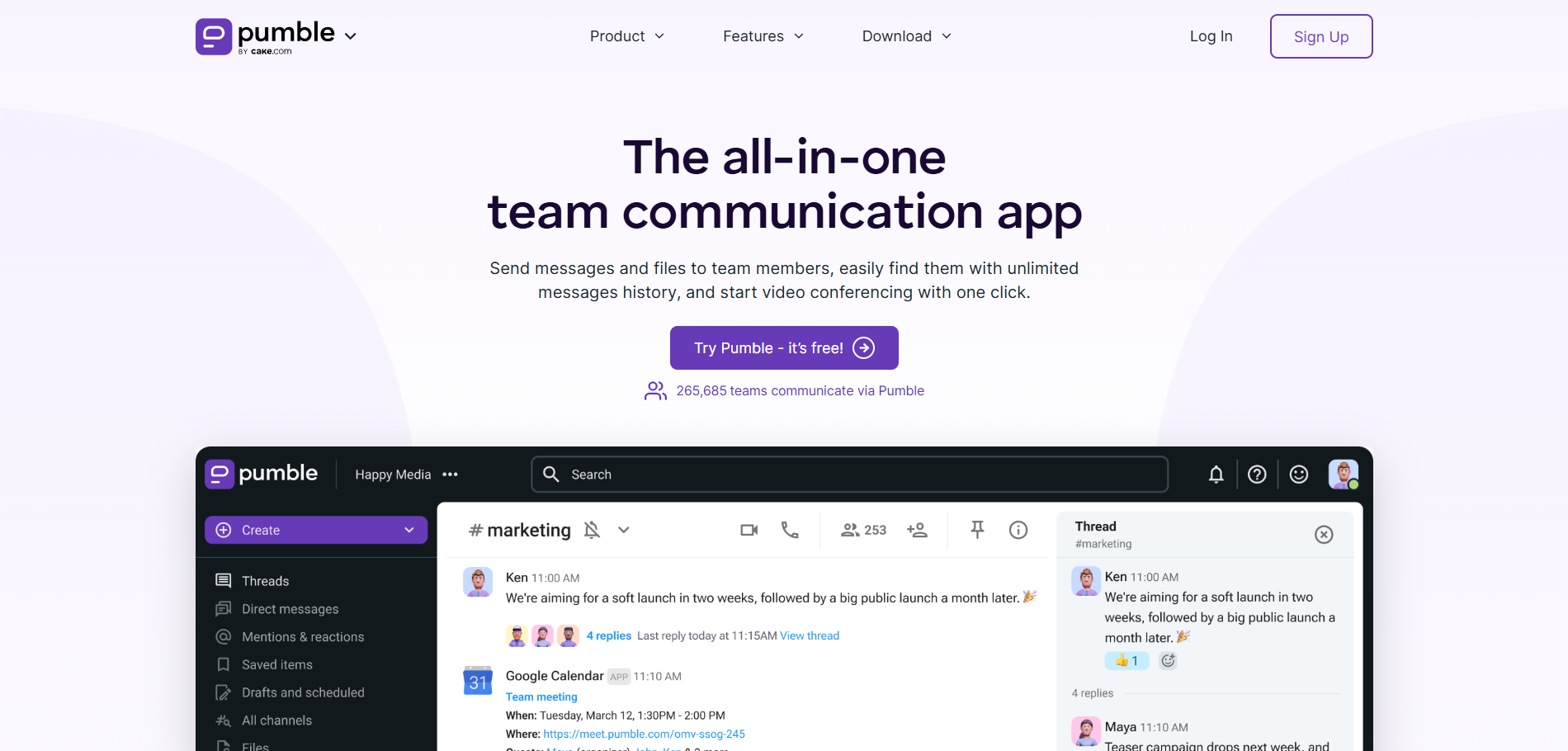
Best for: Teams that want Slack-like functionality with paying less.
Pumble is the unglamorous option that genuinely delivers. It's a Slack competitor built by the same company behind Clockify and Plaky.
It gives unlimited message history on the free plan, 10 GB storage, channels, threads, direct messages, video calls, and screen sharing.
Honest limitations:
UI is functional rather than beautiful
No AI feature set worth mentioning
For small-to-medium teams that find Slack pricing okayish and don't need the full enterprise feature stack, Pumble is the one.
Pricing: Free plan available. Paid from $2.49/user/month.
For privacy-first and open-source communities
4. Rocket.Chat

Best for: Organizations that want to self-host and own their data.
If the question is "what if we could run our own communication platform without exposing our data to anyone," Rocket.Chat is the most mature answer. It's what happens when you take Slack's UX, make it open source, and let organizations host it themselves.
Setup isn't trivial. You'll need a server and some technical competence. But once it's running, you have full control. End-to-end encrypted DMs, and better admin controls. In October 2025, Rocket.Chat launched a native federation scheme allowing separate instances to share rooms across server boundaries. A bold move toward genuine decentralization.
Honest limitations:
The free Community Edition is limited
Paid plans are expensive for a community-focused deployment
Pricing: Free (self-hosted, limited). Cloud/paid plans start with the Pro plan with a custom quote.
5. Discourse

Best for: Forum-style communities where conversations are meant to last.
Discourse is the anti-Discord in the best possible way. Where Discord is chaotic, real-time, and momentary, Discourse is structured, searchable, and built for the long run. Discussions are organized into topics and categories. Everything is indexed. You can find a conversation from two years ago in just 30 seconds.
If your community generates genuine knowledge tutorial threads, in-depth technical discussions, and resource libraries, Discourse is the one it craves.
Discourse is also 100% open source and self-hostable with full access to plugins at no cost. The moderation tools are excellent and unusually transparent. Moderation decisions are public by default, which creates community accountability.
Honest limitations:
Not a real-time chat app
If you need instant responses and casual banter, it will feel slow
Discourse works best as either a standalone forum or paired with a separate tool for real-time chat.
Pricing: Free (self-hosted). Paid plans start from $20/month. Managed full-featured hosting from ~$100/month.
6. Telegram

Best for: Large public channels, creator broadcasts, privacy-conscious communities.
Telegram handles scaling very easily. It can group up to 200,000 members, 4GB file uploads, and fast delivery across every device. For creators who want to broadcast to a large audience with a low-friction tool, it's hard to beat.
The privacy story is more subtle than Telegram's reputation suggests. Telegram works well for announcements and broadcast channels. Only "Secret Chats" are end-to-end encrypted by default. We can say that it’s more private than Discord.
Honest limitations:
Faced scrutiny over content moderation in 2024-2025.
Community management tools are limited.
Doesn't work well for organized community discussion or content gating.
Pricing: Free. Telegram Premium ~$5/month.
7. Signal

Best for: Communities where privacy is the highest priority above everything else.
Signal is the gold standard for encrypted communications, full stop. If your community discusses sensitive topics, operates in a high-risk context, or simply doesn't want any third party accessing your conversations, Signal is the correct answer. You can have a secure group chat without any second thoughts.
Honest limitations:
Not built for community management
No channels, moderation tools, content organization, or search history
Unsuitable for large, organized communities
Pricing: Free (donation-funded).
For gaming communities
8. TeamSpeak

Best for: Competitive gaming, esports, and anyone for whom audio quality is non-negotiable.
TeamSpeak has been around since 2001. It's still the preferred voice communication tool in serious esports and competitive gaming. The audio latency is lower than Discord's, the security model is stronger (own hosting server), and the noise cancellation is excellent. If crystal-clear, low-latency voice is your concern, TeamSpeak delivers it better than anyone.
Honest limitations:
The feature set beyond voice is minimal
Not a full community-focused platform
Pricing: Usually free, but a personal server limits upto 32 users. To increase, you need to upgrade.
For creators and educators who need to build a real business
9. Mighty Networks

Best for: Creator-led communities, courses + community under one roof.
Mighty Networks is probably the most direct Discord replacement for creators who want to run paid communities. It combines discussion spaces, online courses, live events, and member management. Unlike Discord, it actually allows you to make money from it.
The interface is intentional in a way Discord isn't. Members feel like they're joining something structured, not just roaming into a chat room. The onboarding flows, challenge features, and AI tools (Mighty Co-Host) requires less manual work.
The recent versions have added meaningful AI features: automated New Member Journeys, activity scoring that flags who's going quiet, and Co-Host for generating course outlines or landing pages. These are real time-savers for solo creators.
Honest limitations:
Video and audio quality have been reported as inconsistent across multiple Reddit threads in r/mightynetworks
Marketing tools are thin; you'll still need an external email platform for serious campaigns
Transaction fees (2–3% depending on plan) cut your full revenue potential
Customer support faced criticism in recent Capterra reviews for being slow outside US hours
Pricing: From $79/month (annual). Mighty Pro (white-label app) is custom pricing.
10. Circle

Best for: Clean, modern creator communities; courses plus payments in one place.
Circle is the platform that feels the most like "Discord, but built for professionals running businesses." The UI is genuinely polished. Spaces organize your community clearly, live rooms work well for events, and the paid membership integration is also there.
If you've tried to explain Discord to a non-techy audience and watched their eyes glaze over, Circle is the alternative. Members understand immediately what they're looking at.
The analytics have improved significantly in 2025-2026 with AI-powered activity scores and automated nudges to re-engage quiet members.
Honest limitations:
Gets expensive at scale
Lower-tier plans feel limited in customization
Transaction fees (2% on Professional) aren't shown on the pricing page
Email marketing is a paid add-on ($99/month), not included
Workflow automations are locked behind the $199/month Business plan
Pricing: From ~$89/month.
11. EzyCourse

Best for: Educators and course creators who need a full LMS and a community in one platform.
EzyCourse might surprise you if you've only heard of it as a course platform. The community features are genuinely robust. Creators migrating from Discord can worry less because it covers most of the things.
Dedicated community channels
Facebook-style feeds with posts, polls, and reactions
Ability to create multiple spaces for different member groups
Premium and locked channels to lock specific content under memberships
Cross-posting and scheduled posts
Daily or weekly community post digest
Enable or disable post-approval
Public, Private, Hidden, or Restricted Accessibility Settings
Leaderboard and Gamification Badges
The group and private chat experience is real-time, organized, and doesn't need members to learn anything from scratch. Onboarding is better than Discord's, and the overall interface feels purpose-built for paying members.
What pulls it ahead of Circle and Mighty Networks is the 0% transaction fees on all plans. Mighty Networks takes 2–3% of your revenue, Circle takes 1–2%. At any real membership volume, this gap compounds quickly into hundreds of dollars saved per month.
Honest limitations:
No free plan (trial available)
Users face a slight learning curve upfront
Pricing: From Essential $59/month (annual). 0% transaction fees across all plans. 14 Day Free trial available.
How the Top 11 Discord Alternatives Have Performed: Final Scoresheet

How to Select the Right Discord Alternatives?
This is a quick checklist of how you can choose a suitable alternative to Discord for your needs:
If you want to make money from your community: Mighty Networks, Circle, or EzyCourse. They're built for it. Discord isn't.
If you need courses and community together: EzyCourse if the LMS depth matters, Circle if you want something cleaner and advanced.
If you need professional team communication: Slack if budget allows, Pumble if it doesn't, Microsoft Teams if you're already in the Microsoft ecosystem.
If data privacy is the priority: Rocket.Chat (self-hosted) for full control, Discourse for transparent open-source forums, Signal for sensitive private communication.
If you're a gaming community on Discord: Teamspeak is the path of least resistance.
If Discord's age verification is the concern: Any of the above. But check what your members actually need before migrating.
Final Words on the Best Alternative to Discord
What a rollercoaster we enjoyed while suggesting you the top Discord alternatives. Just be sure to focus on the options to find the right platform that you seek.
In our opinion, you can go with the ideal one that offers amazing community features, video/audio analytics, and other helpful features. For that, it can be a good option to try EzyCouse as it offers almost everything you need to replace Discord and even more.
Curious to know more about this platform? Get started with its 14-day free trial to know if it's what you need or not!
Frequently Asked Questions (FAQs)
Q. What is the best free Discord alternative?
For teams: Slack's free tier or Pumble (unlimited message history free). For communities: Telegram for large public groups, Discourse if you're comfortable self-hosting. For gaming: Teamspeak.
Q. What is the best Discord alternative for making money from your community?
Mighty Networks, Circle, and EzyCourse all have monetization built in. EzyCourse can be the best choice if you're running courses or coaching alongside a community. Mighty Networks and Circle are better if community is your primary product.
Q. Why are people leaving Discord in 2026?
Several major issues: the global age verification rollout announced in February 2026, a third-party vendor data breach in late 2025, the 10% cut Discord takes from server subscriptions, and general frustration with limited moderation tools at scale.
Q. Is Slack better than Discord?
For professional teams, a strong yes. For casual communities or gaming, no. They're built for different things.
Q. Is Discord 13+ or 18+?
Discord's minimum age requirement is 13+, though users need to be at least 18 to access age-restricted (NSFW) content. That said, this is exactly why Discord announced global age verification in February 2026.
Q. How does Gen Z use Discord?
Gen Z largely uses Discord as a social layer hangout space with friends, hobby groups, study communities, and fan servers. It functions almost like a hybrid between a group chat and a social network. Interestingly, over 54% of Discord's 259 million monthly active users are now non-gamers, which reflects exactly this shift. Gen Z has repurposed the platform well beyond its original gaming roots into a broader social and interest-based community space.


